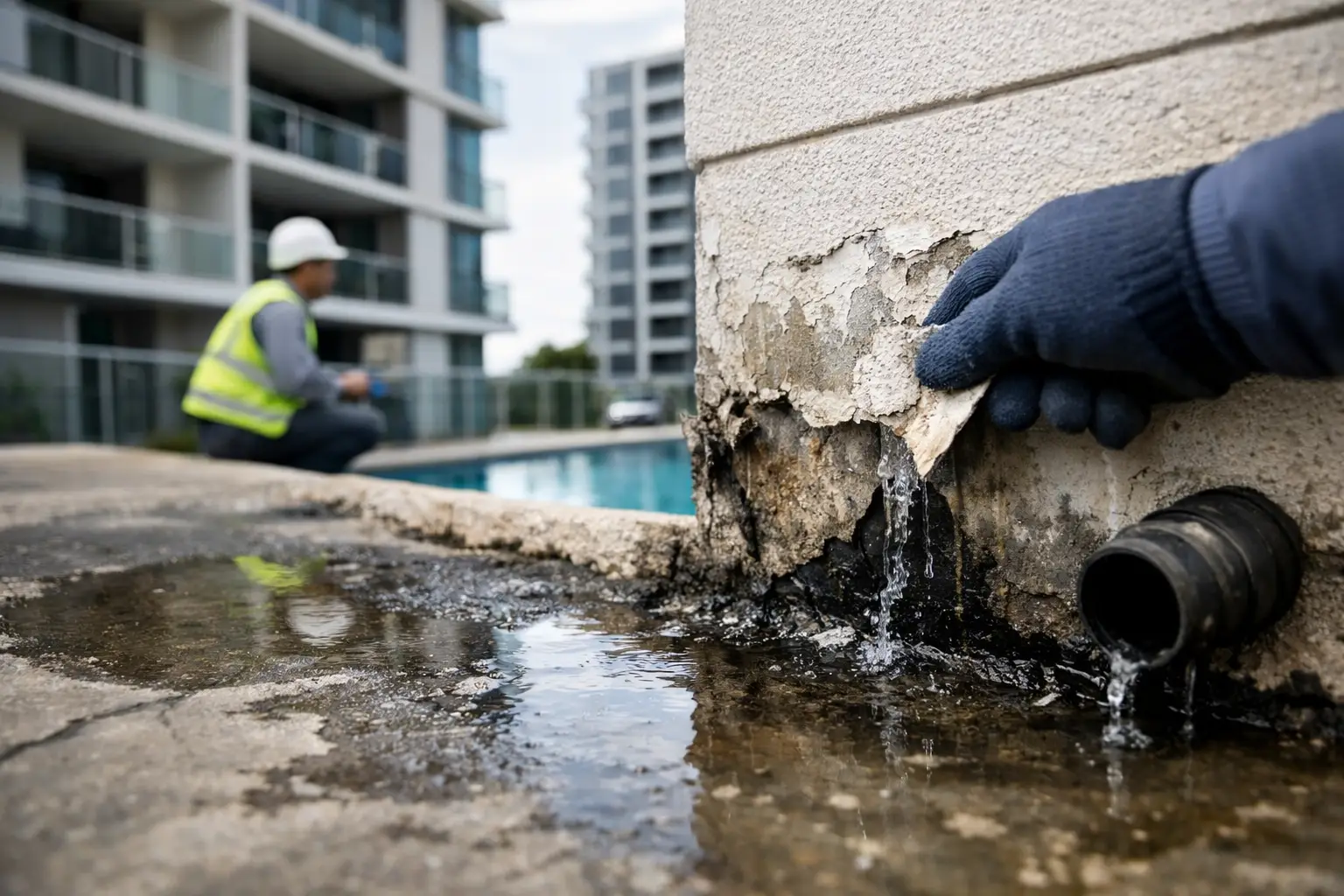
A leaking podium is rarely just a leaking podium. By the time water presents inside lots, stains a soffit or starts lifting finishes in a common area, the failure has usually moved well beyond a simple membrane issue. This strata waterproofing failure case study sets out what that process often looks like in practice – from first symptoms through investigation, scope definition and rectification strategy.
For strata managers and owners corporations, the hard part is not recognising that there is a problem. The hard part is determining whether the visible damage reflects an isolated defect, a broader system failure, or a combination of waterproofing, drainage, movement and construction detailing issues. That distinction affects budget, resident disruption, compliance exposure and the likelihood of repeat failure.
Why a strata waterproofing failure case study matters
In strata buildings, waterproofing defects rarely stay confined to one trade or one element. A failed membrane may be the trigger, but cracking in the substrate, inadequate falls, blocked drainage, poorly terminated flashings, undersized movement joints or unsealed penetrations can all contribute to the same water path. If the repair only addresses the symptom that is easiest to see, the building often ends up paying twice.
This is why a case study approach is useful. It shows how a disciplined remedial process separates probable causes from proven causes, and why intrusive investigation is often necessary before committing to construction.
Project background
Consider a mid-rise strata residential building with a tiled communal podium above basement areas and adjoining occupied apartments. The owners corporation had a long history of intermittent water ingress after heavy rain. Residents reported damp odours, moisture staining to basement ceilings, localised corrosion to metal components and occasional ponding on the podium surface.
Previous repairs had already been attempted. These included tile replacement in isolated areas, surface sealants to joints, patch membrane works and repeated crack injection to accessible locations below. Each measure produced a short-term improvement, but the water ingress returned. That pattern is common in strata assets where defect response is fragmented and driven by urgency rather than diagnosis.
At this stage, the issue was no longer just operational. There were concerns about concealed deterioration, recurrent maintenance costs, contractor overlap, and whether the building was carrying unresolved compliance and duty-of-care risks.
Initial findings from the investigation
The first step was not to nominate a repair system. It was to establish the defect profile. In a waterproofing failure, especially in a shared strata environment, assumptions are expensive.
A proper investigation typically combines visual inspection, moisture mapping, review of original documentation where available, targeted demolition and interface checks across adjoining elements. In this case, intrusive investigation identified several interacting defects rather than one singular cause.
The membrane was compromised, but not alone
The primary waterproofing membrane beneath the tiled finish had deteriorated and, in parts, lost continuity at critical terminations. However, that alone did not explain the extent or pattern of water ingress. The investigation also identified inadequate falls to drainage, which allowed prolonged surface wetting and localised ponding. Over time, that increased hydrostatic pressure at vulnerable points.
Movement and detailing failures were driving recurrence
The podium slab showed evidence of cracking and movement at control joints and transition points. Some movement joints were ineffective, while others had been bridged during earlier repairs. Penetrations and door threshold interfaces were also poorly detailed. In practice, that meant even a new patch membrane in one area would remain exposed to failure at adjacent weak points.
Drainage defects amplified the problem
Several drainage outlets were either poorly set out or functionally restricted. Leaf litter and debris were part of the issue, but the larger problem was design and detailing. Waterproofing systems rely on drainage performance. If water is retained on the surface longer than intended, failure risk increases significantly.
What this strata waterproofing failure case study reveals
The key lesson from this strata waterproofing failure case study is that visible leakage points rarely define the repair boundary. Water can travel laterally, bypass obvious defects and emerge far from the point of entry. That is why patching soffits from below or resealing tiles from above often gives false confidence.
In this case, the building had been treating manifestations rather than the system. The real failure involved the interface between membrane, screed, surface finish, movement detailing, thresholds and drainage. Once that was understood, the repair strategy changed from local patching to coordinated remediation.
Developing the rectification strategy
Once root causes were identified, the next question was proportionality. Not every waterproofing defect requires full replacement, but partial repair only makes sense where the remaining system is demonstrably sound. Here, the defect pattern and history of recurrence pointed to broader failure.
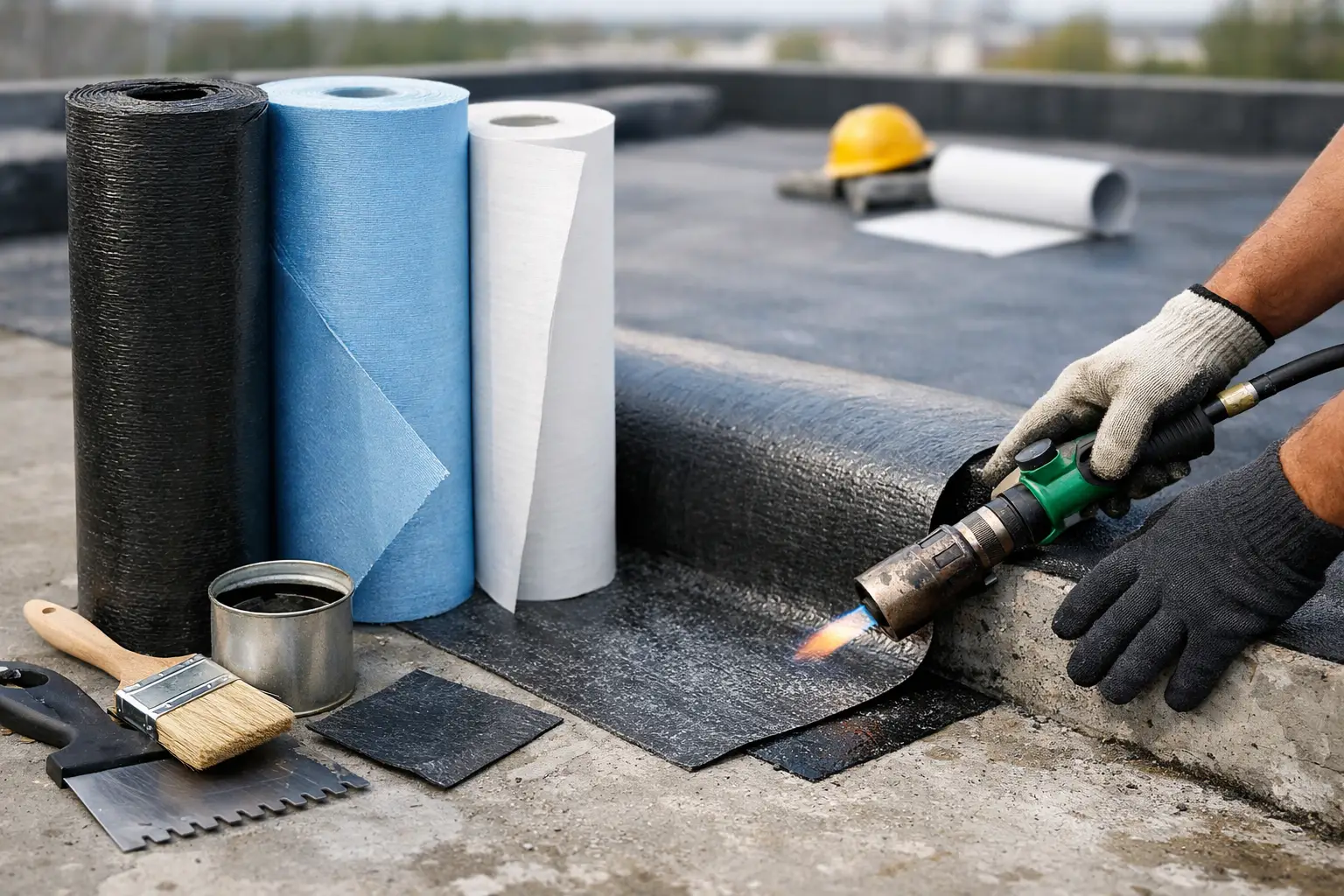
The recommended scope involved removal of tiled finishes and associated build-up in affected podium zones, substrate assessment and repair, reinstatement of compliant falls where required, upgraded detailing at joints and penetrations, installation of a new waterproofing system suited to the exposure conditions, and coordinated reinstatement of finishes.
Just as important was treatment of related defects uncovered during demolition. Local concrete repair was required where moisture ingress had contributed to corrosion and substrate degradation. This is a common crossover in remedial works: waterproofing failure can become a structural durability issue if allowed to persist.
Why staging matters in occupied strata buildings
Rectification in a live strata environment is not just a technical exercise. Access, resident communication, temporary weather protection, noise management and sequencing all affect project success. In occupied buildings, the best technical scope can still fail operationally if staging is poor.
For this reason, the works were planned in sections, with temporary protection measures and clear separation between demolition, substrate repair, membrane installation and finish reinstatement. Hold points for inspection were critical. Once waterproofing is covered, opportunities to verify workmanship reduce sharply.
Compliance and accountability considerations
Waterproofing rectification in Class 2 and mixed-use strata assets needs more than trade coordination. Depending on the building and scope, there may be design documentation, regulated work categories, inspection obligations and certification pathways to address. The point is not to overcomplicate the process. The point is to avoid informal repair methods that create fresh exposure for the owners corporation.
A coordinated remedial pathway provides clearer accountability. It aligns investigation, engineering input where required, specification, buildability review, construction delivery and quality assurance under one framework. That matters in waterproofing defects because disputes often arise from gaps between diagnosis, design and execution.
Outcome and long-term benefit
Following full rectification of the identified failure zones, including drainage improvements and upgraded detailing at interfaces, the building achieved a materially better outcome than it had through earlier patch repairs. The benefit was not simply that water ingress stopped. The benefit was that the repair strategy addressed known failure drivers and reduced the risk of repeated spending on reactive maintenance.
For the owners corporation, that translated into greater certainty around future budgeting, lower disruption to residents, and a stronger basis for ongoing asset management. It also reduced the chance that hidden deterioration would continue progressing behind finishes or within structural elements.
That said, no waterproofing system should be treated as set-and-forget. Long-term performance still depends on maintenance, drainage cleaning, movement monitoring and timely response to new defects. Rectification can correct defective construction or failed systems, but neglect can undermine even a well-executed repair.
When patch repairs are enough – and when they are not
There are cases where localised repairs are justified. A single failed penetration detail, isolated membrane damage from later trade works, or a clearly defined defect in an otherwise sound system may be handled without broad replacement. But that judgement should come after evidence, not optimism.
Where there is a long complaint history, widespread moisture patterning, multiple failed prior repairs, substrate movement or drainage shortcomings, patching is usually a short-term measure. In strata, short-term measures often become expensive habits.
A practical takeaway for strata stakeholders
If a building has recurring leaks, repeated sealant repairs and no clear record of intrusive investigation, the next step should not be another quick fix. It should be a structured defect assessment that tests assumptions and defines the true repair boundary.
That is where experienced remedial practitioners add value. The goal is not to prescribe the largest possible scope. It is to establish what has failed, why it has failed, what else has been affected, and what rectification pathway will stand up technically, operationally and from a compliance perspective.
For Sydney strata assets in particular, exposure conditions, ageing construction stock and the complexity of occupied remedial works make that discipline even more important. Waterproofing failure is rarely resolved by surface treatment alone. Buildings perform better when the response is coordinated, evidence-based and accountable from diagnosis through delivery.
The most helpful question an owners corporation can ask is not, how do we stop this leak this week. It is, what do we need to understand now so we are not dealing with the same defect again next year.