Concrete spalling on a balcony edge, car park soffit or façade is rarely an isolated surface defect. Once reinforcing steel begins to corrode, the decision between cathodic protection vs concrete replacement can determine whether a building receives a lasting remediation strategy or a sequence of recurring patch repairs. The right answer depends on the corrosion mechanism, the extent of deterioration, structural requirements, access constraints and the building’s intended service life.
For strata committees, asset managers and property owners, this is not simply a question of choosing the lower initial cost. It is a decision about managing safety, disruption, compliance exposure and long-term capital expenditure.
Why concrete deteriorates
Reinforced concrete protects embedded steel through its naturally alkaline environment. Over time, carbonation can reduce that alkalinity, while chloride contamination from coastal exposure, salt-bearing materials or environmental conditions can break down the protective layer around reinforcing steel. Water ingress accelerates both processes.
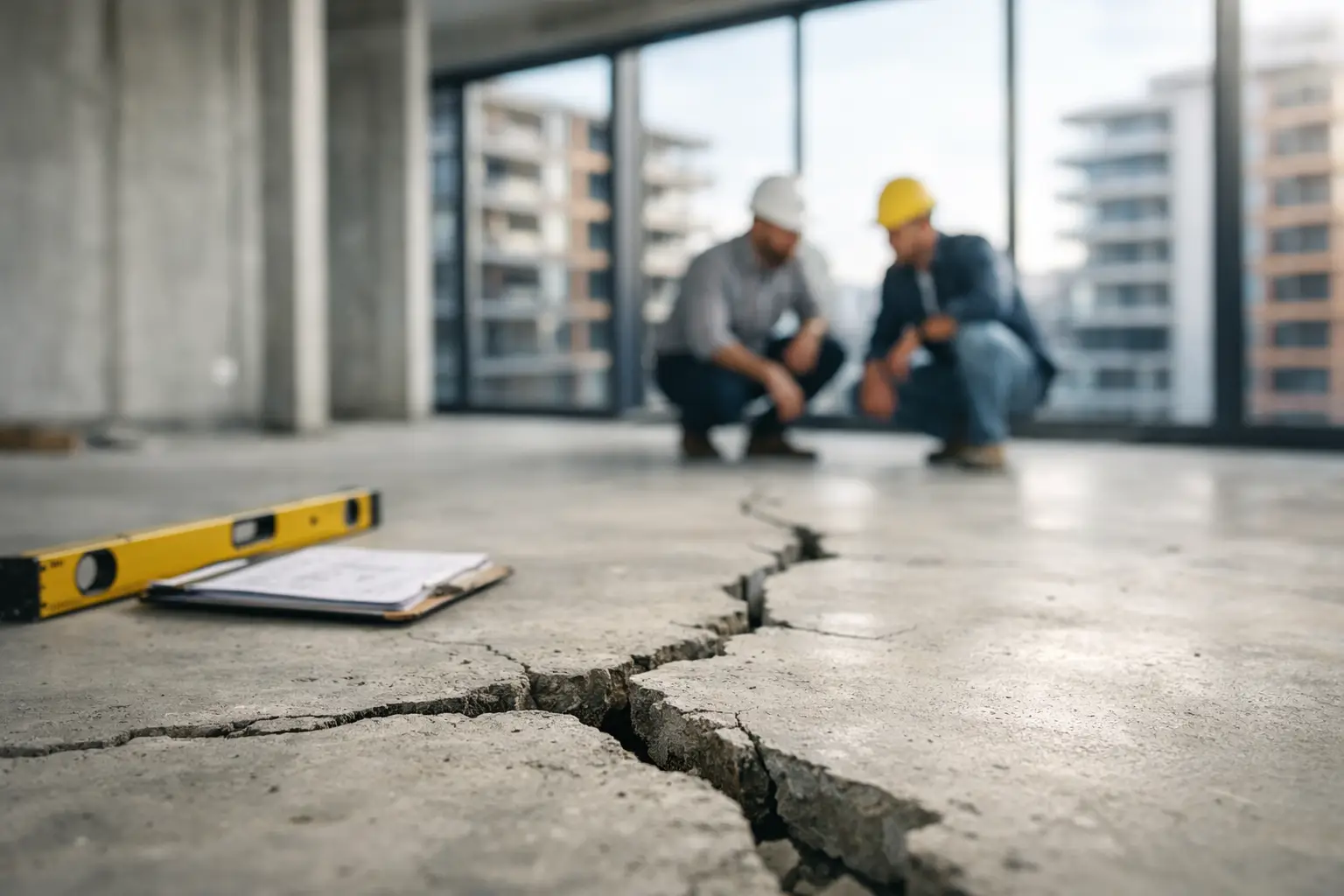
When steel corrodes, it expands. This expansion places pressure on the surrounding concrete, causing cracking, delamination and eventual spalling. The visible concrete loss is therefore a symptom. The underlying issue is an active electrochemical corrosion process, often combined with failed waterproofing, inadequate concrete cover, poor drainage or movement-related cracking.
A repair strategy should address the cause and extent of deterioration, not merely reinstate the broken concrete surface.
Cathodic protection vs concrete replacement: the core difference
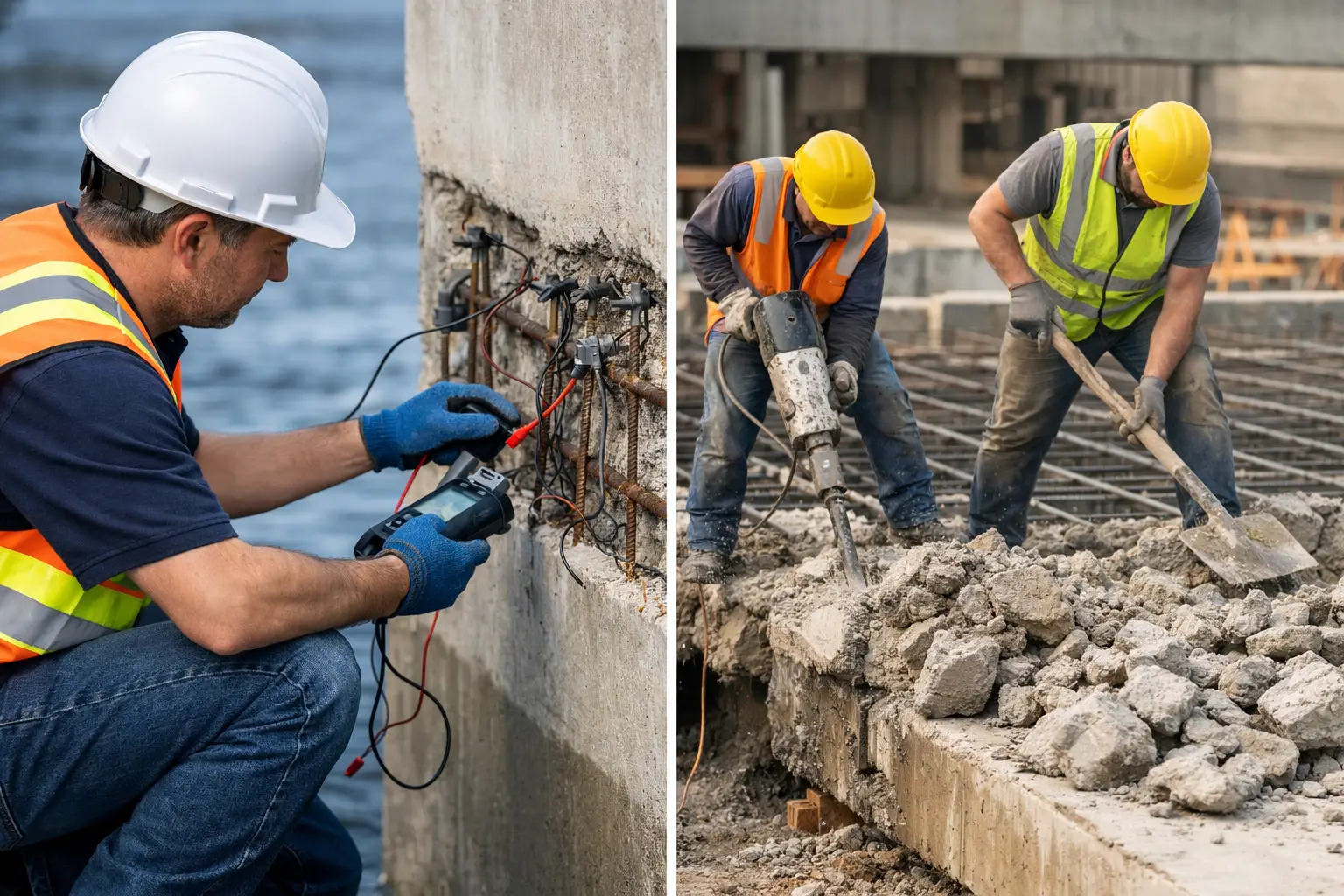
Concrete replacement removes defective or contaminated concrete, treats or replaces affected reinforcement where required, and reinstates the section with a compatible repair mortar or concrete system. It is a localised physical repair method, although it can be applied at significant scale where deterioration is extensive.
Cathodic protection controls corrosion by altering the electrochemical conditions around the reinforcement. It supplies a protective current to the steel through an anode system, reducing the corrosion activity that causes concrete damage. Depending on the system and exposure conditions, this may be achieved through impressed-current cathodic protection or galvanic anodes.
The distinction matters because cathodic protection can protect steel beyond the visible repair area. Concrete replacement generally treats the locations where defective concrete has been identified and removed. If corrosion is widespread but only a proportion of the concrete has visibly spalled, patch-only repairs can leave adjacent reinforcement vulnerable to continued deterioration.
That does not mean cathodic protection eliminates the need for concrete repairs. Delaminated, cracked or structurally unsound concrete must still be removed and reinstated. Cathodic protection is often used alongside targeted concrete repair, rather than as a complete alternative to it.
When concrete replacement is the stronger option
Concrete replacement is usually appropriate where deterioration is isolated, the surrounding concrete remains sound, and investigation confirms that corrosion risk is limited to defined locations. It may also be necessary where section loss has affected structural capacity, reinforcement requires replacement, or concrete damage is too advanced for protection alone to be appropriate.
For example, a small number of local spalls caused by a discrete waterproofing failure may be resolved through concrete repair combined with rectification of the water entry point. In this case, installing a building-wide cathodic protection system may add unnecessary cost and operational complexity.
Replacement is also often the practical choice where a building element is being substantially reconstructed for other reasons. A severely deteriorated balcony slab edge, parapet or car park element may require engineered demolition and reinstatement to restore geometry, load capacity, fire performance or connection details.
However, replacement should not be treated as a universal solution. Removing large volumes of apparently sound concrete simply because some areas are affected can be disruptive, costly and structurally complex. It can also create new interfaces that require careful detailing and curing to achieve durable performance.
The risk of patch repair without a broader strategy
One common issue is the development of new corrosion around the perimeter of a completed patch. This can occur when the repaired area changes electrochemical conditions and corrosion activity concentrates in adjacent contaminated concrete. It is often described as the incipient anode effect.
This does not mean patch repairs are inherently unsuitable. It means their extent, material compatibility and relationship to the wider corrosion condition must be properly assessed. Where contamination or carbonation is widespread, repeated local repairs may become a reactive maintenance cycle rather than a durable remediation program.
When cathodic protection should be considered
Cathodic protection is most valuable when reinforcement corrosion is widespread, ongoing and likely to affect areas beyond current visible damage. It is particularly relevant for concrete structures with chloride exposure, broad carbonation fronts, recurring spalling, or a history of patch repairs that have not delivered the expected service life.
Common applications include parking structures, podium slabs, coastal façades, wharf-related structures and large reinforced concrete elements where comprehensive concrete removal would be highly disruptive. In Sydney, buildings exposed to marine conditions or persistent moisture can require a more detailed assessment of chloride-related corrosion risk.
An impressed-current system is typically designed for larger or more complex structures. It includes an anode arrangement, cabling, power supply and monitoring equipment. The system must be designed by appropriately qualified specialists, commissioned correctly and maintained throughout its operational life.
Galvanic systems use sacrificial anodes and may suit localised repairs or defined areas where a passive, lower-maintenance arrangement is appropriate. Their performance and design life are dependent on concrete condition, moisture, electrical continuity and the level of protection required.
Cathodic protection is a long-term asset management commitment. It requires access for inspection, monitoring and, for impressed-current systems, ongoing power and periodic adjustment. A system that cannot be safely accessed or monitored is unlikely to deliver its intended value.
Investigation should come before selection
Choosing between cathodic protection and concrete replacement without a condition investigation is a high-risk approach. Visual inspection identifies symptoms, but it cannot reliably establish the full extent of corrosion or the mechanism driving it.
A coordinated investigation may include concrete sounding, cover meter surveys, half-cell potential mapping, concrete resistivity testing, carbonation testing, chloride analysis, core sampling and selective breakout inspections. Structural engineering review may also be required where section loss, cracking or load-bearing elements are involved.
The findings should establish whether corrosion is localised or widespread, whether reinforcement has lost meaningful section, how far contamination has progressed, and whether moisture management or waterproofing failures are contributing to the problem. This information supports a repair specification that is proportionate to the risk.
For Class 2 buildings, the repair scope may also require coordination with registered design practitioners and engineers, particularly where structural work, façade remediation or waterproofing interfaces are involved. Clear design documentation, hold points, quality records and rectification details help create an accountable path from diagnosis through construction.
Comparing cost, disruption and service life
Initial cost can make concrete replacement appear more attractive, particularly where the visible damage is limited. Yet the better financial measure is often whole-of-life cost. If patch repairs must be repeated every few years as corrosion progresses through untreated areas, the cumulative cost, access requirements and resident disruption can exceed the cost of a broader protection strategy.
Cathodic protection may involve higher upfront design, installation and commissioning costs. It can, however, reduce the need for widespread concrete removal and extend the useful life of sound but at-risk concrete. Its value is strongest where the alternative is extensive demolition, repeated patching or major disruption to occupied areas.
Concrete replacement can provide an immediate and visible outcome, especially where damaged sections need urgent reinstatement for safety. It also avoids the ongoing operational obligations associated with an active cathodic protection system. Its success, however, depends on removing defective material to the correct extent and correcting the water, contamination or detailing issues that initiated corrosion.
Neither option should be assessed in isolation. Waterproofing, drainage, joint condition, façade sealing, crack treatment and protective coatings may all form part of the final remediation scope.
A coordinated repair strategy produces better outcomes
The most reliable projects begin with a defined diagnosis, then bring engineering, design, approvals, access planning and construction delivery into one coordinated program. This avoids the common gap between a consultant’s repair recommendation and a contractor’s practical delivery method.
For complex remedial works, the preferred strategy may be targeted concrete replacement combined with cathodic protection in high-risk zones, waterproofing repairs to stop moisture ingress, and protective treatments to manage future exposure. The scope should be based on evidence, not assumptions or the convenience of a single repair method.
Before approving works, ask whether the proposed solution explains the cause of corrosion, defines the condition of the broader structure, identifies ongoing maintenance requirements and provides a credible design life expectation. A repair that looks complete at handover is not necessarily one that has controlled the process causing the damage.
The practical aim is not to use the most sophisticated system or remove the most concrete. It is to select an engineered, maintainable solution that restores safety and protects the building asset for the years ahead.