
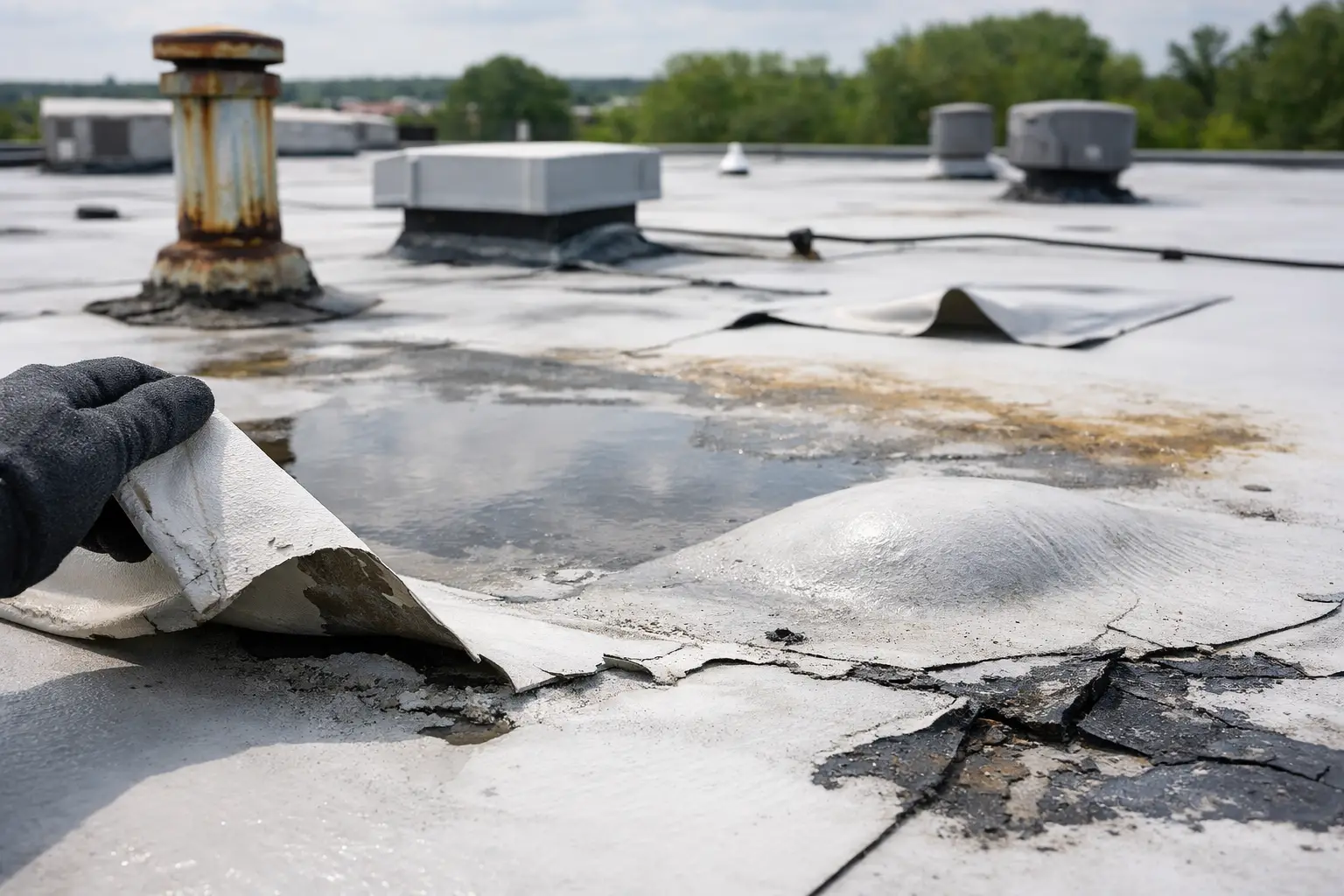
A roof rarely fails all at once. In most multi-unit and commercial buildings, the early warning signs show up weeks or months before a major leak, often in places that seem unrelated to the roof itself. For strata committees, owners corporations and asset managers, recognising roof membrane failure signs early can make the difference between a targeted repair and a much larger remediation project.
Membrane systems are designed to provide a continuous waterproof barrier, but they are exposed to movement, ponding water, UV degradation, detailing defects and workmanship issues over time. Once the membrane is compromised, water does not always enter directly below the defect. It can track through falls, insulation, slab penetrations, joints and wall interfaces before appearing internally. That is why visible symptoms need to be treated as indicators for investigation, not assumptions about the source.
Why roof membrane failure signs are often missed
One of the common issues with roof defects is that the first symptom is often dismissed as a maintenance problem. A ceiling stain may be patched and painted. Surface cracking around a parapet may be sealed locally. Mould around a top-floor wall may be blamed on ventilation alone. Those responses can mask the real issue while water continues to enter the building fabric.
In remedial work, the concern is not just the leak itself. Prolonged water ingress can affect insulation performance, ceiling finishes, internal fitout, structural elements, electrical services and occupant amenity. In some buildings, particularly older strata stock or complex Class 2 assets, persistent roof waterproofing failures can also expose broader defects in detailing, falls, drainage or previous repair methodology.
1. Internal water staining on upper floors
Ceiling staining on the highest occupied level is one of the clearest roof membrane failure signs, but it still needs careful interpretation. The stain may appear as brown discolouration, bubbling paint, sagging plasterboard or localised dampness after rain. In some cases it only becomes visible after heavy storm events, which can lead building stakeholders to underestimate the severity.
The key issue is repeatability. If staining returns after patch repairs or worsens over time, the problem is unlikely to be cosmetic. Water may be entering through a split seam, failed termination, membrane puncture or poorly detailed penetration. It can also indicate that the membrane is allowing ingress around upturns, planter interfaces or rooftop plant areas.
2. Ponding water that lingers well after rain
Some membrane systems can tolerate limited temporary ponding, but persistent standing water is a risk factor that should not be ignored. If water remains on the roof for 48 hours or more after rainfall, it may point to inadequate falls, blocked drainage, substrate deflection or localised settlement.
Ponding accelerates membrane ageing and places additional stress on laps, joints and terminations. It also increases the chance of minor defects turning into active leaks. In practical terms, a roof that holds water is a roof that deserves investigation, even if internal leaks have not yet appeared.
3. Blistering, bubbling or lifting in the membrane
Visible distortion in the membrane surface is a strong sign that the waterproofing system is under stress. Blisters and bubbles can form due to trapped moisture, poor adhesion, substrate contamination, vapour pressure or installation defects. Lifted edges and loose sections may suggest bond failure or movement at the substrate.
Not every blister means immediate full replacement. It depends on the membrane type, age, extent of the defect and whether the waterproof layer has been breached. But where bubbling is widespread, particularly near laps or details, it often points to a systemic issue rather than an isolated imperfection.
4. Cracking at joints, parapets and penetrations
The field area of a roof membrane matters, but many failures start at transitions. Penetrations, upturns, door thresholds, service mounts, expansion joints and parapet junctions are high-risk areas because they combine movement, detailing complexity and exposure.
If you can see cracking, splitting or separation around these points, there is a reasonable chance water can enter during wind-driven rain or ponding events. These locations should be inspected with the broader system in mind. A local crack may reflect substrate movement, poor termination method, incompatible materials or failed sealant that has allowed progressive deterioration behind the visible surface.
5. Mould, odour or persistent dampness near top-floor walls
Not all membrane failures announce themselves through obvious drips. In some buildings, the first sign is a persistent musty smell, mould growth in upper-level apartments or dampness around cornices and wall junctions. Because these symptoms can also be associated with condensation, they are sometimes treated as internal environmental issues rather than external waterproofing defects.
The distinction matters. If dampness worsens after rain, appears near roof perimeters or affects multiple lots along the same elevation, roof or podium waterproofing failure becomes a strong possibility. Investigation should consider parapet cappings, membrane upturns, flashing interfaces and facade junctions, not just the horizontal roof surface.
6. Deterioration around roof drainage points
Roof outlets and overflow provisions are common failure points because they concentrate water and are subject to movement, debris build-up and repeated wetting. Signs such as rust staining, cracking, loose grates, membrane shrinkage around outlets or localised ponding can indicate that the drainage detail is no longer performing as intended.
Where outlet detailing is defective, water ingress may remain concealed for some time. It can enter slab edges or service zones before becoming visible internally. In strata and commercial settings, this can create a misleading pattern of complaints across different tenancies or common areas.
7. Recurrent leaks after previous repairs
A recurring leak is one of the most useful diagnostic clues available. If a roof has already been patched but the problem returns, there is a strong chance the original repair addressed the symptom rather than the cause. This is common where contractors rely on surface-applied sealants or isolated patches without confirming moisture pathways, membrane condition or detailing failures.
Repeated repair cycles also tend to complicate later remediation. Multiple incompatible products, trapped moisture and inconsistent workmanship can make the roof harder to assess and more expensive to rectify properly. At that point, a disciplined defect investigation is usually more valuable than another quick fix.
8. Surface ageing that has moved beyond normal wear
All membranes age, but not all ageing is benign. Shrinkage, embrittlement, exposed reinforcement, UV breakdown, seam fatigue and loss of elasticity suggest the membrane may be approaching the end of its serviceable life. The risk increases where maintenance has been inconsistent or where rooftop traffic, plant installation or ad hoc penetrations have disturbed the system.
Age alone does not confirm failure. Some roofs perform well beyond expected timeframes if they were well designed, properly installed and regularly maintained. Others fail early because of poor substrate preparation, design limitations or detailing errors. The condition assessment needs to focus on actual performance, not just the installation date.
What these signs usually mean in practice
For building stakeholders, the real question is not whether a roof looks imperfect. It is whether the observed signs indicate isolated damage, design-related deficiency or broader system failure. That distinction affects scope, budget, access planning, consultant involvement and compliance obligations.
A single puncture caused by service trades may be suitable for a localised repair if the surrounding membrane remains sound. Widespread blistering, chronic ponding and repeated leakage across several areas usually suggest that a larger remediation strategy is needed. On occupied buildings, that strategy also needs to consider staging, resident communication, safety controls and weather exposure during works.
When to investigate roof membrane failure signs formally
If water ingress is affecting occupied spaces, if leaks are recurring, or if the roof services a multi-residential or commercial asset with shared ownership responsibilities, formal investigation is the sensible next step. That may include visual inspection, moisture testing, review of existing details, falls assessment, drainage review and selective opening-up where required.
For Sydney buildings, this can be particularly relevant after heavy rainfall periods when latent defects become active. It is also important where roof waterproofing interfaces with facades, balconies, planters or plant platforms, because the source may sit across more than one building element.
The value of proper investigation is accountability. Rather than guessing at the cause, the process establishes what is failing, why it is failing, and what repair methodology is appropriate for the building’s condition and use.
A disciplined response is cheaper than repeated patching
The cost issue is often misunderstood. Building stakeholders sometimes delay investigation to avoid a larger spend, yet repeated reactive repairs can quietly become the more expensive path. They rarely address concealed moisture, they may allow structural deterioration to continue, and they can increase disruption for occupants over time.
A more dependable approach is to treat roof membrane failure signs as triggers for diagnosis. That means assessing the membrane in context, coordinating repair scope with the relevant building elements, and selecting a remediation pathway that aligns with long-term asset performance rather than short-term appearance. For strata and commercial properties alike, that is usually where the real savings sit.
If your roof is showing early signs of waterproofing distress, the most useful step is not another patch – it is finding out exactly what the building is telling you before the damage spreads.