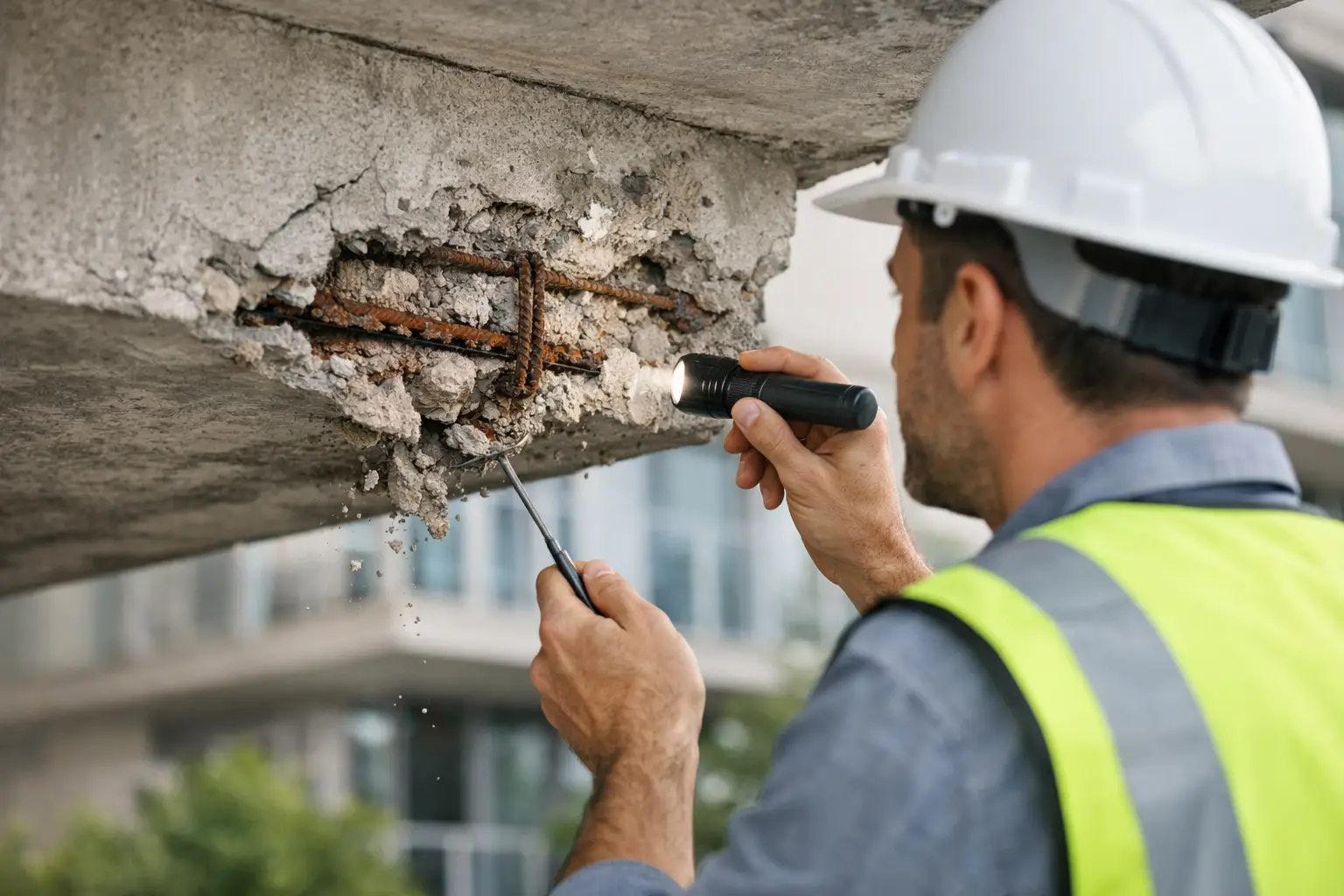
Concrete cancer rarely begins with a dramatic failure. More often, it starts as a small rust stain below a balcony edge, a hairline crack in a car park soffit, or a hollow-sounding patch of concrete on a façade. Knowing how to identify concrete cancer early gives owners corporations, strata managers and asset managers time to investigate the cause, manage safety risks and plan a durable repair rather than responding to an escalating defect.
Concrete cancer is the common industry term for reinforced concrete deterioration caused by steel reinforcement corrosion. It is not a surface-only problem. Where corrosion is active, the visible damage may represent only part of the affected area, which is why a disciplined investigation is essential before repair works are scoped.
What concrete cancer looks like
Reinforced concrete contains steel bars that provide tensile strength. In sound concrete, the steel is protected by the alkaline environment within the concrete cover. When water, chlorides or carbon dioxide penetrate that protective cover, the reinforcement can corrode. As steel rusts, it expands, placing pressure on the surrounding concrete until cracking, delamination and eventual spalling occur.
The most recognisable signs are rust-coloured staining, cracking that follows the line of reinforcement, loose or drummy concrete, and areas where concrete has broken away to expose steel bars. These symptoms can occur on apartment balconies, slab edges, basement ceilings, planter boxes, retaining walls, podiums, façade elements and marine-adjacent structures.
Visible exposed steel is a clear warning sign, but it is not the only one. Early-stage corrosion may be concealed behind apparently intact concrete. A repair strategy based only on the visibly damaged patch can leave active deterioration immediately beside the repair boundary.
How to identify concrete cancer: key warning signs
A visual inspection is a useful starting point, particularly after heavy rain or during scheduled building maintenance. Look for patterns, not isolated blemishes. Concrete cancer often follows moisture pathways, construction joints, cracks, drainage points or recurring waterproofing failures.
Rust staining and discolouration
Brown or orange staining on concrete is often associated with corroding reinforcement. It may run down a wall, appear at the underside of a slab, or emerge from fine cracks along a balcony edge. Staining does not always confirm the full extent of corrosion, but it warrants further assessment, especially where it recurs after cleaning.
Cracks parallel to reinforcement
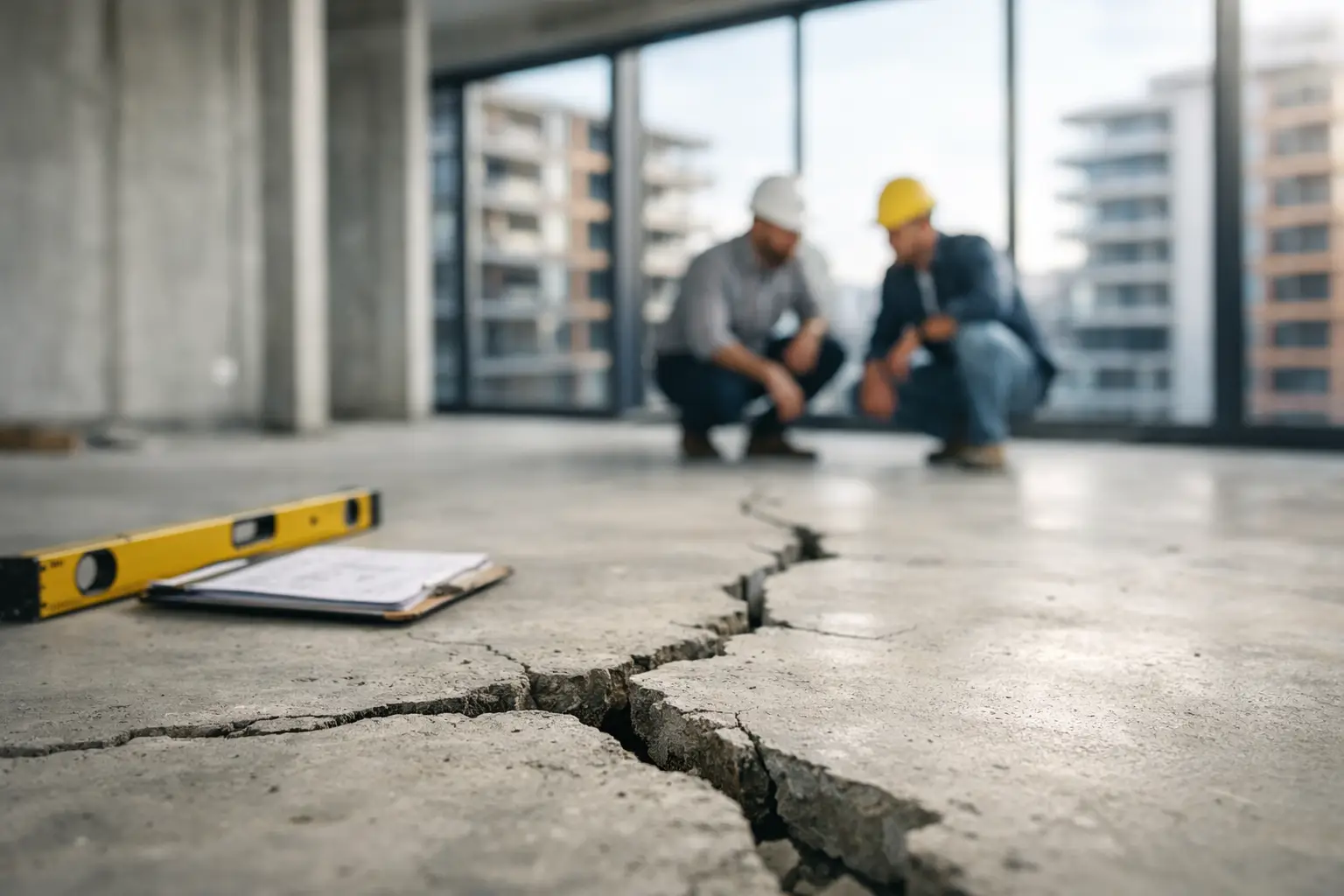
Long, relatively straight cracks can indicate corrosion expansion around reinforcing bars. These cracks are commonly found along slab edges, beam soffits and columns. Not every crack is caused by concrete cancer – movement, shrinkage, thermal change and structural loading can also produce cracking – but crack location, width and pattern help determine the likely mechanism.
Spalling, delamination and hollow concrete
Spalling occurs when a section of concrete breaks away. Before this happens, the concrete may become delaminated, meaning it has separated internally from the substrate. A trained practitioner may identify these areas through controlled hammer sounding, where a hollow or drummy response suggests a loss of bond.
Spalled concrete creates an immediate concern on elevated elements such as balconies, façades and car park ceilings. Falling fragments can injure occupants or the public, damage vehicles and create liability for the responsible building entity. Loose material should be treated as a safety issue, not simply an aesthetic defect.
Exposed or displaced reinforcement
Where steel reinforcement is visible, heavily rusted or no longer properly embedded in concrete, timely action is required. Corrosion reduces the effective cross-section of the steel and can compromise the bond between steel and concrete. The structural significance depends on the element, the extent of steel loss and the engineer’s assessment.
Persistent water ingress
Water ingress is one of the strongest indicators that conditions may exist for concrete deterioration. Leaking balconies, failed membranes, blocked drainage outlets, defective flashings, cracked façades and planter box leaks can all introduce moisture into concrete. In Sydney’s coastal environment, airborne salts can also increase the risk of chloride-related corrosion, particularly on exposed buildings near the coast.
Why a visual inspection is not enough
The visible concrete defect is often the consequence of a deeper issue. For example, replacing a small spalled patch on a balcony slab may improve its appearance, but if a failed waterproofing system continues to admit water, corrosion can restart or emerge in adjacent locations.
A proper defect investigation establishes the extent of deterioration and identifies the cause. Depending on the building and symptoms, this may include close-up inspection, hammer sounding, concrete cover measurement, reinforcement location scanning, moisture testing, carbonation testing, chloride testing and selective concrete breakout. Engineers may also assess cracking, reinforcement condition and structural capacity where deterioration is substantial.
This investigation-led approach matters because concrete cancer repairs require more than removing loose concrete and applying mortar. The repair design must address contaminated or unsound concrete, prepare and protect reinforcement, reinstate the concrete profile with compatible repair materials, and resolve the moisture source where relevant. Each stage affects the durability of the completed work.
Distinguishing concrete cancer from other defects
Several building issues can resemble concrete cancer. Efflorescence, for instance, appears as a white crystalline deposit caused by moisture carrying salts through masonry or concrete. It signals water movement but is not itself evidence of steel corrosion. Surface crazing and shrinkage cracking may also be superficial, though they can provide pathways for water ingress over time.
Concrete cracking caused by structural movement requires a different response to corrosion-related cracking. Likewise, staining from a rusted metal fixture or balcony balustrade does not necessarily mean reinforcement within the concrete is corroding. This is why diagnosis should not rely on appearance alone.
The practical question is not simply, “Is there a crack?” It is: what is causing it, how far has the defect progressed, and what repair system will prevent recurrence? Those answers determine whether minor maintenance is appropriate or whether coordinated remedial works are needed.
What to do when you suspect concrete cancer
If signs of spalling or exposed reinforcement are present, begin by managing immediate safety. Restrict access beneath affected areas where there is a risk of falling concrete, document the location and condition with dated photographs, and arrange a professional inspection. Avoid removing substantial concrete or coating the area before assessment, as this can conceal evidence and make diagnosis more difficult.
For strata and commercial properties, record the issue within the building maintenance or defect register. Note whether it is associated with water ingress, recent weather events, particular elevations, balconies or basement areas. This information helps establish patterns across the asset and supports informed decisions by the owners corporation or building manager.
The next step is to engage suitably qualified remedial building and engineering professionals to investigate the defect. The scope should be proportionate to the risk. A small, isolated surface defect may need targeted assessment, while recurring spalling across a façade, podium or car park may require systematic condition mapping and an engineered repair programme.
What a durable repair usually involves
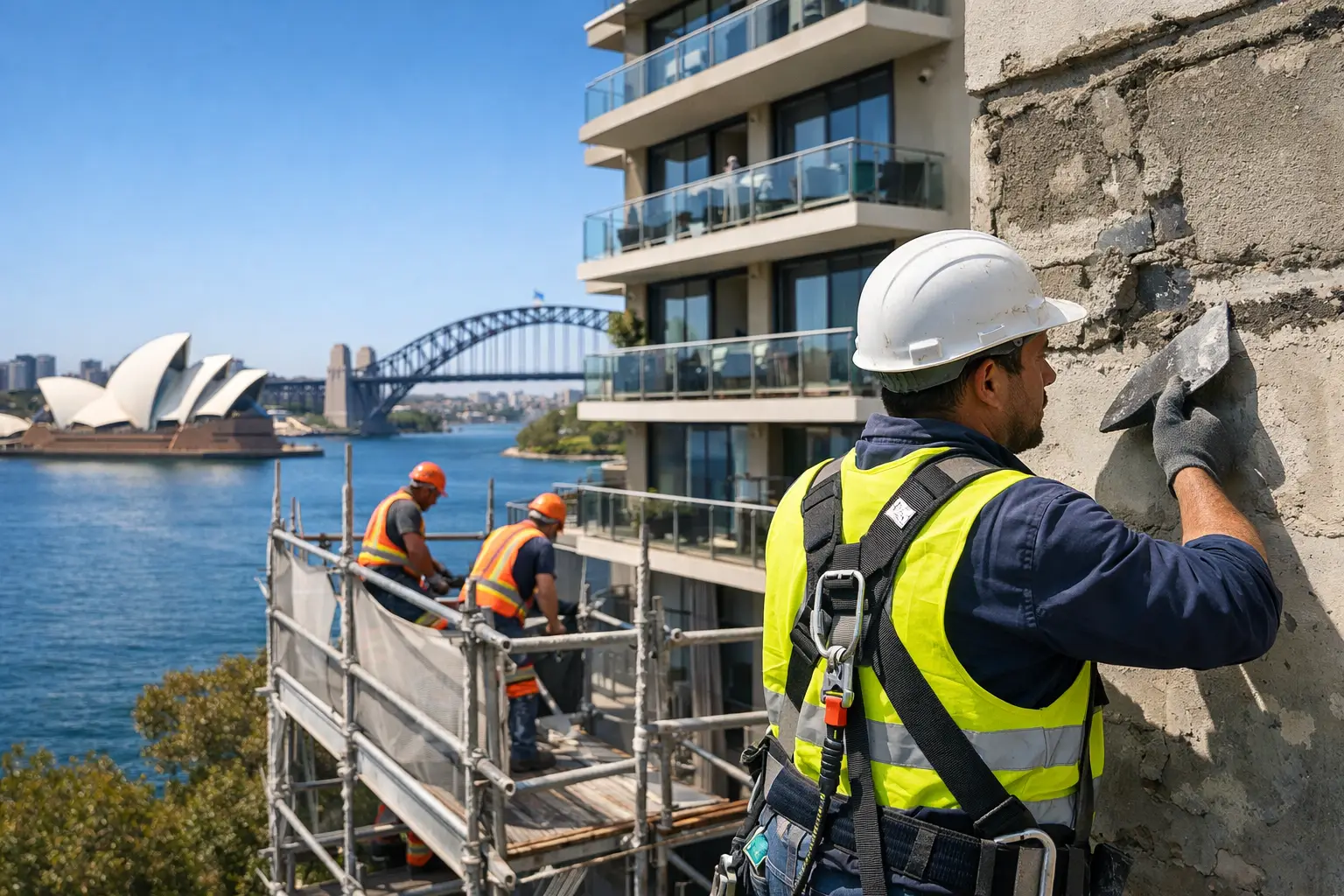
A compliant repair sequence is developed from the investigation findings rather than assumed at the outset. In broad terms, repairs may involve removing unsound concrete beyond the visibly damaged area, cleaning and assessing reinforcement, replacing or supplementing steel where specified by an engineer, applying corrosion protection, reinstating the concrete with compatible repair mortar, and curing the repair correctly.
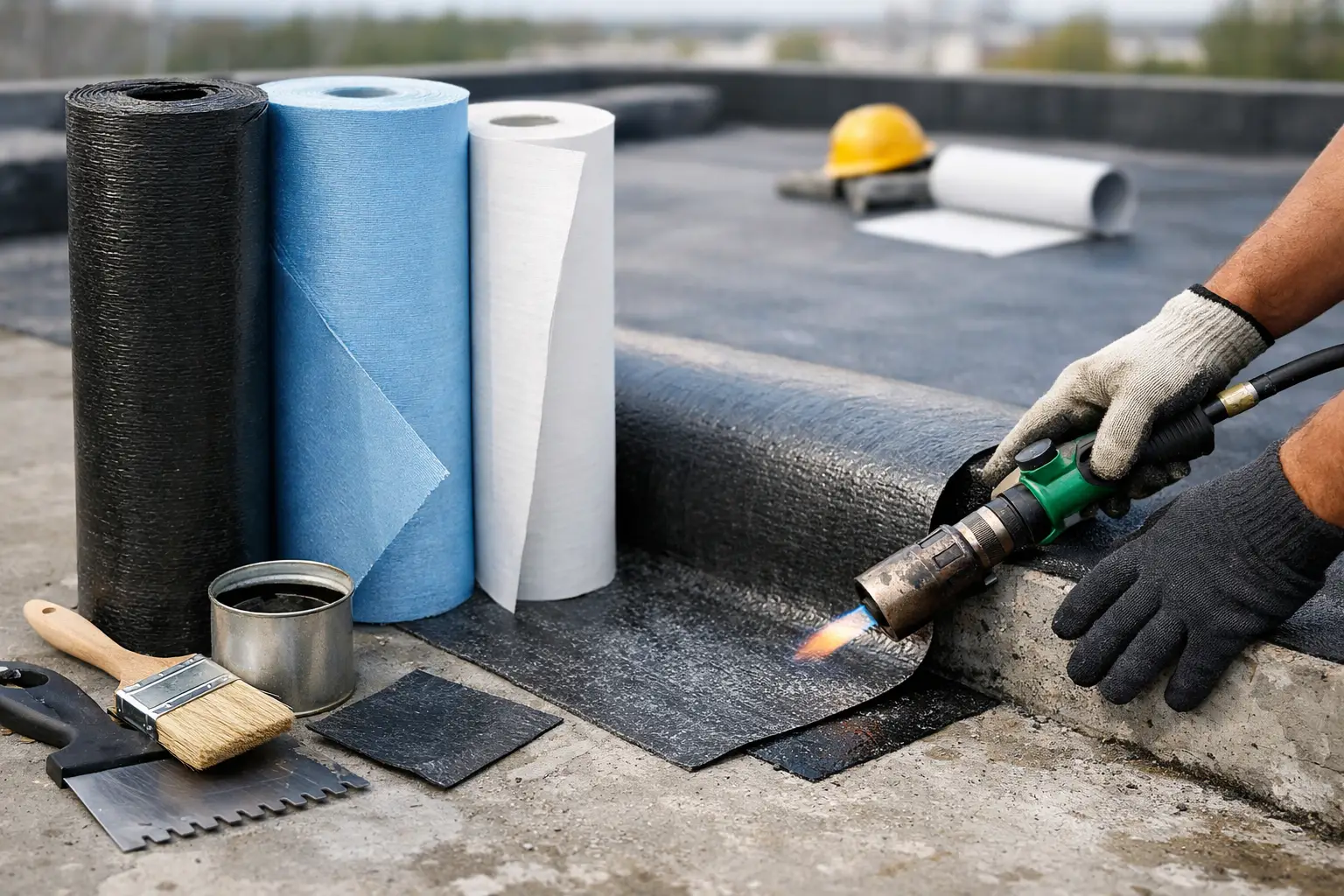
Where water is the driver, associated works may include waterproofing replacement, crack treatment, drainage corrections, joint repairs or façade sealing. Protective coatings can form part of a broader system, but they should not be used as a substitute for removing deteriorated concrete or resolving active water entry.
Access, resident impacts, staged work zones, dust management and approvals also need careful planning on occupied buildings. For Class 2 residential projects, the applicable design, compliance and practitioner requirements must be considered from the beginning. Coordinated delivery reduces the risk of a fragmented outcome where investigation, engineering, waterproofing and repair works are treated as unrelated tasks.
When the issue becomes urgent
Treat the matter as urgent where concrete is actively falling, reinforcement is exposed on a structural element, cracks are widening, water is entering occupied areas, or deterioration is present above pedestrian routes, entries, parking bays or public spaces. The same applies where deterioration affects balconies, parapets, façade panels or overhead car park slabs.
Urgency does not mean rushing into an unverified repair scope. It means making the area safe while arranging the right level of assessment. Temporary controls can reduce immediate risk, but they are not a long-term solution to reinforcement corrosion.
Concrete cancer is manageable when it is identified accurately and addressed at its source. Early reporting, careful investigation and an engineered, coordinated repair approach protect people, preserve the building asset and help avoid the greater cost of widespread deterioration later.