
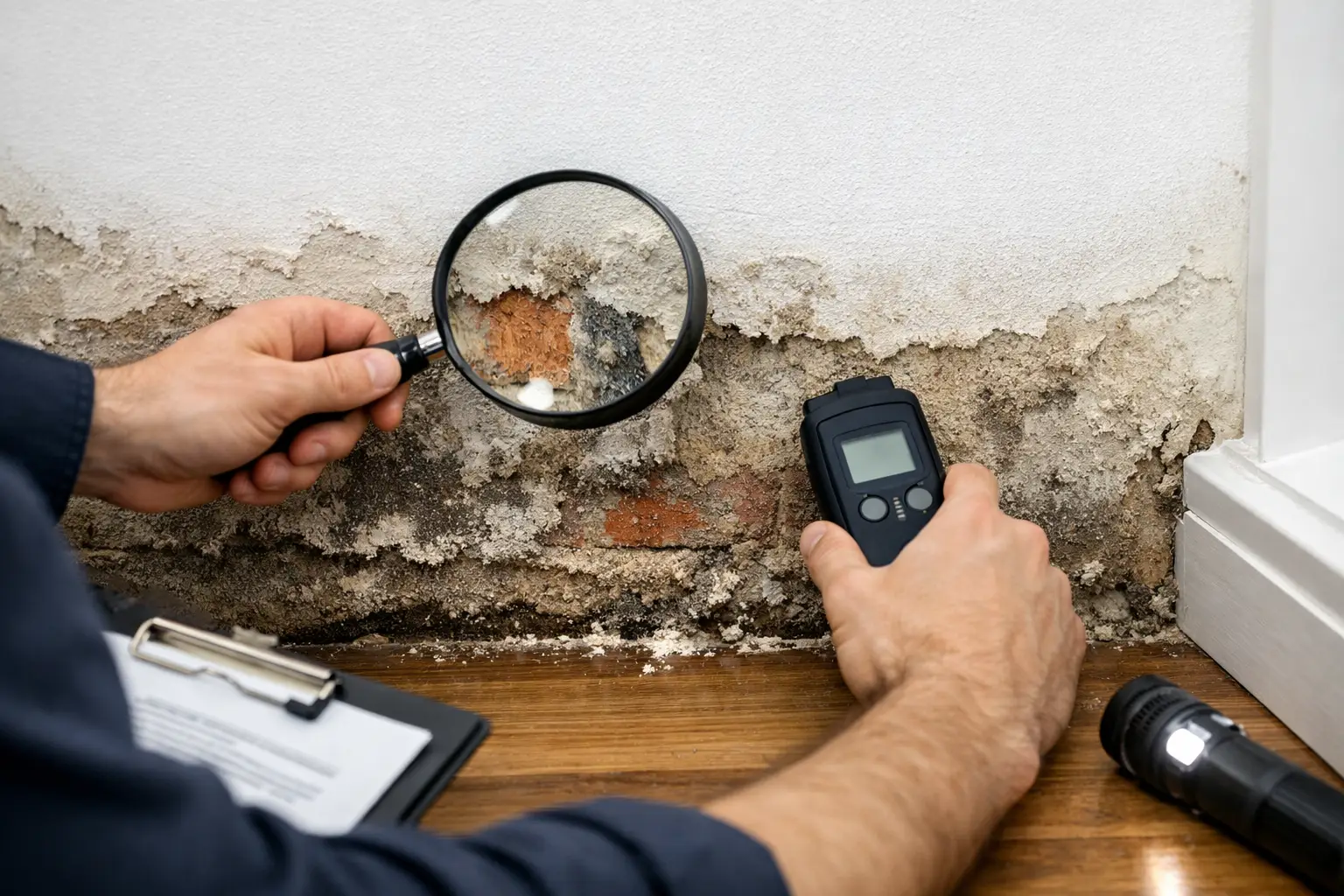
A tide mark on an internal wall is often where costly guesswork begins. By the time paint is bubbling, skirtings are swelling or salt staining has appeared, many buildings have already been misdiagnosed once – and sometimes repaired for the wrong problem. If you need to know how to diagnose rising damp, the starting point is not treatment. It is distinguishing genuine capillary moisture movement from the many other defects that look similar on site.
Rising damp is a specific failure pattern. It occurs when groundwater is drawn upward through porous masonry by capillary action, usually where an effective damp-proof course is absent, bridged, failed or no longer performing as intended. That sounds straightforward, but in practice the symptoms overlap with leaks, condensation, surface runoff, cavity issues, slab edge moisture and failed waterproofing. For strata properties, commercial assets and older buildings, that distinction matters because the repair pathway, cost and compliance implications can be very different.
How to diagnose rising damp without jumping to conclusions
The first step is to treat rising damp as a hypothesis, not a finding. A visual inspection can suggest the possibility, but it cannot confirm it on its own. Too many moisture issues are labelled as rising damp simply because damage sits low on a wall.
A proper diagnosis starts with pattern recognition. Genuine rising damp usually presents at the base of masonry walls. You may see localised staining, blistering paint, deteriorated plaster, decayed skirtings and a horizontal moisture line. Salts are another common indicator. As groundwater rises through masonry, it can carry soluble salts that crystallise within the wall surface or plaster, leaving a white powdery deposit or causing finishes to break down.
Even then, the pattern has to make sense in the context of the building. If moisture is concentrated around a wet area, below a window, adjacent to a downpipe, behind an external garden bed or only after rainfall, another source is more likely. Rising damp is usually more consistent and tied to the lower wall zone rather than a single plumbing fixture or facade junction.
What signs actually point to rising damp?
Low-level damage is the most recognised sign, but it should be read alongside the wall construction, site conditions and adjacent defects. Masonry walls are more susceptible than lightweight framed walls because capillary movement occurs through porous materials such as brick, mortar and some renders.
The common signs include a visible tide mark up the wall, often below one metre, damaged plaster or render near floor level, paint failure, staining, salt deposits and deterioration of skirting boards or joinery fixed against the wall. A musty odour may also be present where prolonged moisture has affected finishes.
What matters is whether those signs form a coherent moisture pattern. A uniform low band of deterioration along a ground floor masonry wall may support a rising damp diagnosis. Patchy damage isolated to one corner may not. Likewise, if there is active mould growth on a cold internal wall with poor ventilation, condensation may be the primary issue even if the skirting has started to deteriorate.
Check the building conditions that allow rising damp to occur
Rising damp does not appear in a vacuum. It usually reflects a failure in moisture separation between the ground and the wall base.
Start by identifying whether the wall should have a damp-proof course and, if so, where it is located. In older buildings, the original damp-proof course may be absent, degraded or concealed by later works. In some cases, external paving, garden beds, render, topping slabs or landscaping changes bridge the damp-proof course and allow moisture to bypass it.
External ground levels are a critical part of the assessment. If soil, paving or finishes sit too high against the wall, moisture transfer becomes more likely and ventilation to the wall base may be reduced. Blocked subfloor vents, poor drainage falls and persistent ponding around the perimeter can also increase moisture loading at the base of walls.
For multi-unit and strata properties, look beyond a single tenancy boundary. Moisture movement may be influenced by common property drainage, slab interfaces, planter boxes, retaining walls or facade defects elsewhere in the building envelope.
Use moisture testing carefully
Moisture meters can help, but they are often misunderstood. They are useful screening tools, not standalone proof of rising damp.
A non-invasive moisture meter may indicate elevated readings at the base of a wall, but those readings can also be affected by salts, metallic materials and substrate variation. Resistance-type meters can be more targeted, yet they still need interpretation. If the wall contains hygroscopic salts, readings may remain high even when the wall is no longer actively wet.
That is why competent diagnosis relies on combining moisture data with the visible defect pattern and building context. In more complex cases, further investigation may include salt analysis, invasive inspection, thermal imaging or review of construction details. The aim is not to collect data for its own sake. It is to isolate the moisture source with enough confidence to define an effective repair scope.
Rule out the defects that mimic rising damp
This is where many assessments either become reliable or fall apart. Several common defects can produce the same low-level symptoms.
Leaking plumbing is one of the first alternatives to exclude, especially near bathrooms, laundries, kitchens and service risers. Stormwater ingress is another. If the wall becomes wetter after rain, inspect external drainage, downpipes, flashings, facade cracks and sealant junctions before assuming groundwater is rising through the masonry.
Condensation should also be considered, particularly in buildings with poor ventilation, thermal bridging or air-conditioning imbalance. While condensation typically affects cooler surfaces and can encourage mould growth, it does not usually create the same salt-laden tide mark associated with true rising damp.
Bridging is another common issue. A wall may have a functional damp-proof course, yet external finishes or internal screeds can carry moisture above that level. In those cases, the problem is not classic rising damp in the strict sense, but the symptoms can look similar and the repair strategy will be different.
Why laboratory-style certainty is not always available on site
Property stakeholders often want a simple yes or no answer. On live buildings, particularly older or altered assets, moisture diagnosis is not always that clean. Previous repairs, concealed construction, multiple active defects and changes in ground levels can blur the picture.
That does not mean the diagnosis should be vague. It means the investigation needs to be disciplined. A reliable assessor will identify the probable mechanism, the evidence supporting it, the limitations of the inspection and what additional investigation is needed before major rectification proceeds. That is especially important where works may affect heritage fabric, common property responsibilities or Class 2 compliance obligations.
When rising damp is more likely in Sydney buildings
In Sydney, rising damp concerns often emerge in older masonry buildings, properties with altered landscaping, and assets where waterproofing and drainage upgrades have been carried out inconsistently over time. Coastal exposure, dense urban sites and legacy construction details can all complicate moisture behaviour.
For strata and commercial stakeholders, the key issue is less about whether the building is old and more about whether there is a credible path for ground moisture to move into the wall system. That requires inspection of the site, not assumptions based on age alone.
What a proper diagnosis should lead to
If rising damp is confirmed, the next step is not a generic treatment product. It is a repair strategy aligned with the cause. That may involve removing bridging conditions, improving drainage, reinstating separation at the wall base, replacing salt-contaminated finishes or coordinating broader remedial works where moisture has affected adjacent materials.
If the diagnosis is wrong, those works may do little more than delay further damage. That is why experienced remedial practitioners focus on root-cause analysis before proposing rectification. For owners corporations, asset managers and property owners, that approach reduces the risk of spending capital on cosmetic works while the underlying moisture pathway remains active.
At Remedial Building Practitioners, that kind of investigation-led process is central to durable building repair. Moisture defects rarely exist in isolation, and low-level wall damage often sits within a wider pattern of envelope, drainage or detailing failures.
The practical test is simple: if the signs are visible but the cause is still uncertain, the building is not ready for treatment yet. It is ready for a more rigorous diagnosis – because the cost of being confidently wrong is usually far higher than the cost of investigating properly.